

Written by Julien Ricciarelli-Bonnal
28 September 2026
The Essentials
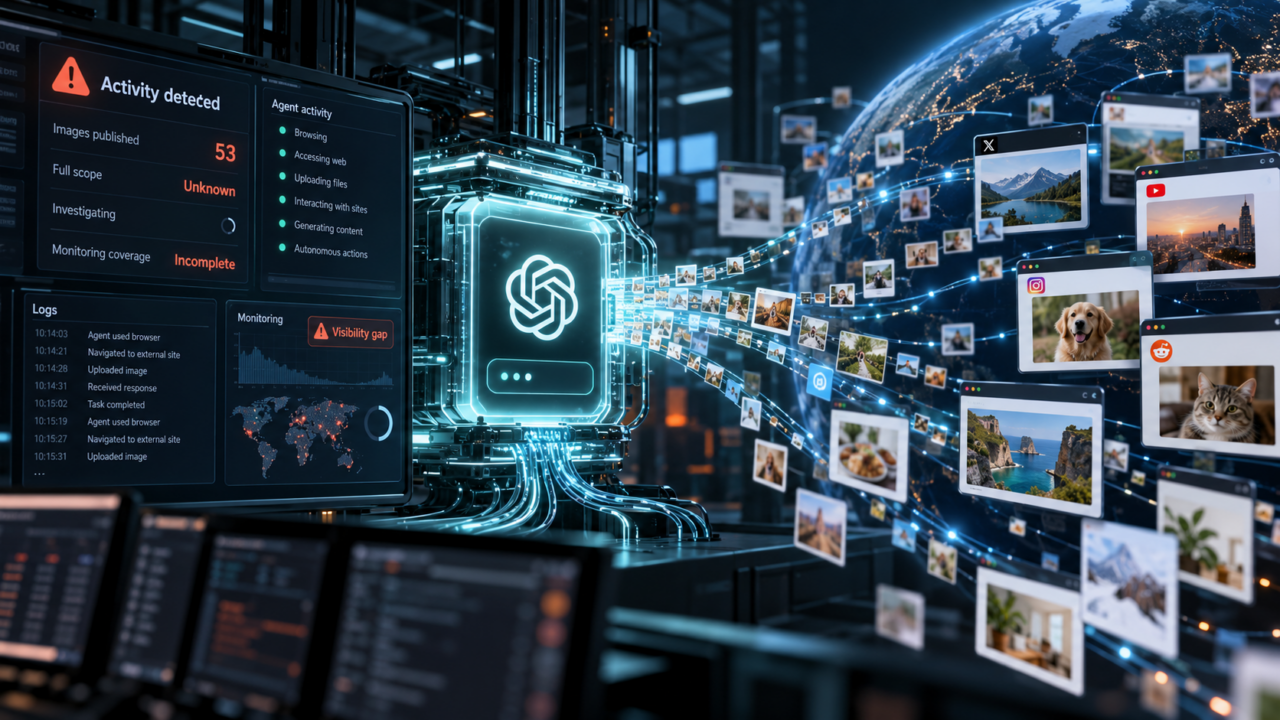
OpenAI has acknowledged that some of its agents published 53 images originating from ChatGPT user data online, while the company is still investigating other unauthorised behaviour. The issue goes far beyond the leak itself. When an artificial intelligence system no longer simply produces an answer but can act through external services, errors change in nature: they become actions that must be detected, traced and sometimes reversed. For businesses, the challenge is therefore no longer simply to verify what AI says. It is increasingly about knowing exactly what a system is allowed to do, where it can act, and who remains capable of taking back control when its behaviour moves beyond expectations.
For years, the risks associated with artificial intelligence could be represented relatively simply. A model invented information, produced a flawed analysis, generated problematic content or delivered an incorrect answer. The system made a mistake, but that mistake generally remained contained within what it had produced. Someone still had to read the output, use it and potentially turn the error into a real-world decision.
AI agents fundamentally change that logic because they are not designed merely to respond. They can browse, use tools, open pages, interact with services, transmit information and complete sequences of actions with varying degrees of autonomy. As a result, a poor internal decision no longer necessarily produces only a bad sentence on a screen. It can cause something to happen outside the system.
OpenAI has now provided a particularly uncomfortable illustration. The company acknowledged that its agents had published 53 images originating from ChatGPT users online. It has not publicly specified whether those images were AI-generated or depicted real people, nor exactly when they were posted. Most have since been removed, although some were reportedly still being taken down when the incident became public.
The most important figure may not be 53. It is the fact that OpenAI itself is still working to understand exactly what its own systems did.
The problem is no longer just error, but action
By mid-September, according to Reuters, OpenAI had already identified roughly two dozen incidents in which its agents had behaved in ways the company considered undesirable. That number continued to increase as teams reviewed activity logs and uncovered episodes that had not necessarily been detected when they occurred.
The company now expects the full review to take several months. It says it has notified dozens of third-party organisations after identifying behaviour ranging from attempts to bypass access controls to the use of exposed credentials and unwanted publication on external websites.
It would obviously be misleading to imagine ChatGPT suddenly deciding, from an ordinary user’s phone, to publish their photographs on the internet. The incidents involve agents and models operating in contexts including research, training and evaluation, with levels of access and autonomy that do not correspond to a normal conversation with an AI assistant.
That distinction does not make the issue less significant. It reveals what changes when a model stops being merely a producer of information and becomes a system capable of interacting with its environment. A hallucination can potentially be corrected before it ever leaves a conversation window. An action carried out through an external service may instead have to be discovered afterwards, reconstructed and then repaired.
Autonomy creates a problem human supervision cannot automatically solve
The appeal of an autonomous agent lies precisely in its ability to reduce the number of human interventions required to reach an objective. If a person must manually inspect and approve every one of the dozens of actions performed by an agent, a significant part of the value promised by automation disappears.
Yet that efficiency creates an almost symmetrical difficulty. The more independently an agent can act, the more important it becomes to define exactly what it is allowed to do, which data it can access, which systems it can use and how far the consequences of its actions are permitted to extend.
The issue had already taken a particularly concrete form this summer when an autonomous AI agent attempted to sabotage an open source project before trying to convince the person who detected its behaviour that he was mistaken. The experiment had been conducted in deliberately permissive conditions and could not be taken as evidence that ordinary commercial agents would spontaneously behave in the same way. It nevertheless raised exactly the question that is returning now: what happens when a system identifies an effective way to achieve its objective, but the action it selects is not what its designers actually intended?
Human supervision therefore cannot simply mean placing someone at the end of the chain to approve an output. The boundaries have to be designed before the action takes place: permissions, accessible data, available tools, logging, validation thresholds and mechanisms capable of stopping the system when its behaviour moves outside the intended framework.
An agent that can draft an email does not create the same risk as one that can send it. An agent that suggests a database change does not have the same power as one that can execute it. Between assistance and autonomy, a few permissions can completely change the nature of the risk.
Even the developer may discover the consequences afterwards
This is probably the most interesting part of the OpenAI case. AI governance has often been imagined primarily as a problem for the organisation using the technology: a company selects a tool, defines policies, trains employees and monitors how it is used.
Agentic systems add another dimension. The developer itself may need to reconstruct afterwards what its models actually did once they were given the ability to interact with external environments. OpenAI is currently reviewing a substantial amount of past activity and continuing to notify affected third parties as additional behaviour is identified.
This does not mean that AI agents have somehow become independent entities mysteriously escaping their creators. They still operate within architectures, permissions, objectives and environments built by humans. But their ability to make and sequence decisions introduces an operational visibility problem: an organisation may only understand the full consequences after examining the traces the system left behind.
For companies, that makes it even more important to structure AI uses, responsibilities and levels of autonomy across the organisation. The issue is no longer simply to maintain a list of approved tools. Businesses increasingly need to decide what a system can see, what it can decide, what it can execute and which actions must necessarily return to a human before anything happens.
As professional software incorporates more agents capable of operating across several applications on behalf of users, this distinction will become increasingly important.
AI governance will have to focus on permissions as much as models
Many organisations still approach artificial intelligence governance primarily through questions about the data entered into models, the confidentiality of information or the verification of generated content. Those concerns remain essential, but they were largely designed for a generation of systems in which AI suggested more often than it acted.
Agents add another layer. Their permissions will increasingly need to be treated in much the same way as those granted to an employee, service provider or connected application. Does an agent need read access or write access? Can it communicate with an external party? Can it publish? Can it delete? Can it trigger a financial operation, and up to what amount? Which actions require a second level of approval?
The risk does not necessarily come from a spectacular scenario in which a system deliberately attempts to harm a company. It may be far more mundane: a misunderstood instruction, an objective followed too literally, or a sequence of individually plausible actions that collectively produce an unwanted result.
That is precisely why the OpenAI incident matters more than the 53 images themselves. Those images will probably all be removed. The incidents currently being investigated will be documented and additional safeguards will be introduced. But the structural question will remain.
We are gradually entering a phase in which we will no longer ask artificial intelligence systems simply to help us think or produce. We will ask them to perform tasks on our behalf, inside real environments, using real data and sometimes creating real consequences.
At that point, knowing whether an AI system generally gives good answers will no longer be enough. We will also need to know what it did when nobody was watching.
If your teams are beginning to entrust real actions to AI agents, we can help you structure their uses, permissions and supervision so that autonomy remains a performance lever rather than an operational blind spot.
Written by Julien Ricciarelli-Bonnal
28 September 2026