


Written by Julien Ricciarelli-Bonnal
3 October 2026
The Essentials
Meta has released the code needed to connect its Muse AI agent to ESP32 boards, Raspberry Pi computers, displays, buttons, sensors and other accessible hardware. The company has even created its own Muse Home Link, with 5,000 units planned, allowing community-built skills to control different devices around the home. Behind the playful DIY angle, the announcement points to something much more significant: artificial intelligence is gradually leaving the screen. Instead of remaining confined to an app, browser or chat interface, it is becoming a software layer that developers, companies and enthusiasts can increasingly embed directly into physical objects.
For several years, using artificial intelligence almost always meant opening an interface. A website, application, chat window or piece of software acted as the gateway to the model. Even when AI became integrated into professional tools, it usually remained identifiable as a feature the user deliberately activated.
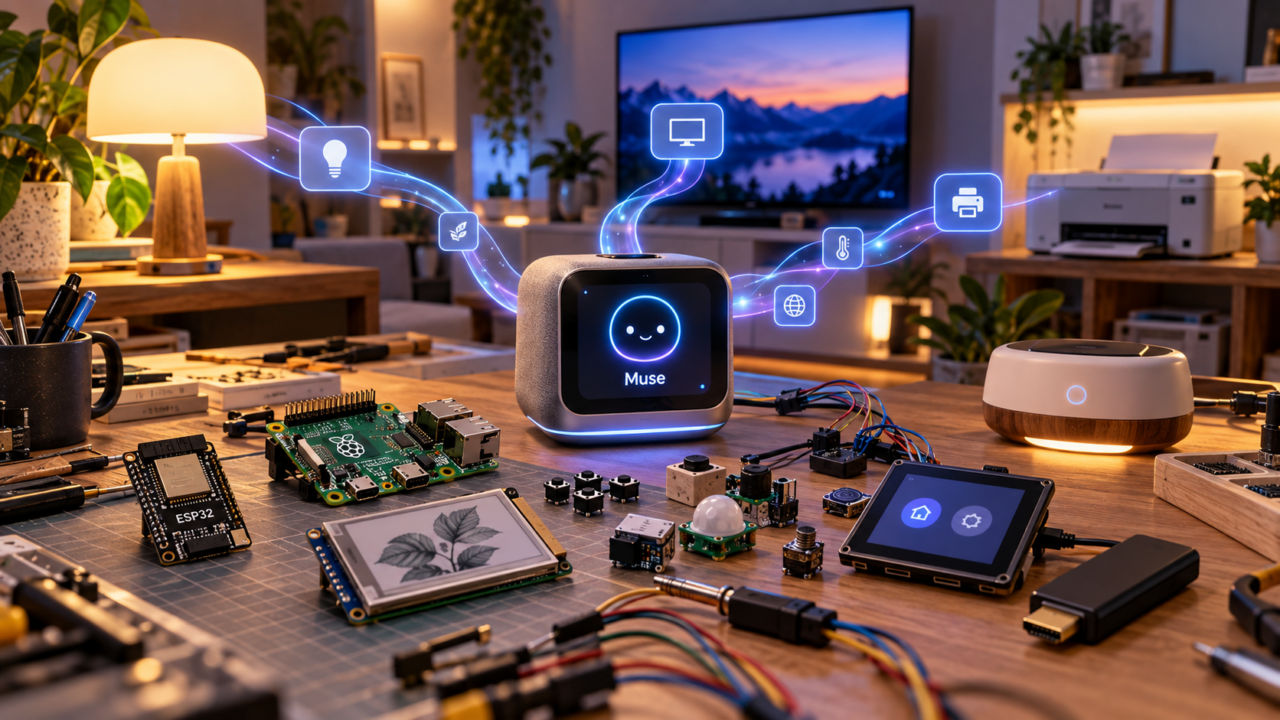
Meta is now pushing Muse in a different direction. The company has made it possible to connect its agent to relatively accessible hardware including ESP32 boards, Raspberry Pi computers, small touchscreens, E Ink displays, buttons, sensors and other components. A developer can therefore begin designing an object in which artificial intelligence is not simply an application running on top of the product, but part of the way the product itself operates.
The examples remain deliberately simple. Muse can appear on an E Ink display to provide reminders, run on a small touchscreen, or be connected through HDMI to a television. Meta’s Muse Home Link goes further by allowing community-built skills to control lights, televisions or printers. None of these individual functions is particularly revolutionary, but the significance lies in how easily they can now be assembled around the same AI layer.
AI is starting to become a component rather than a product
The shift resembles what happened with the internet. In its early years, being connected meant sitting in front of a computer and opening a browser. Over time, connectivity disappeared into the objects themselves: phones, televisions, cars, watches, speakers and home appliances. Users no longer consciously think about “using the internet” every time they stream a programme or ask a connected speaker for information.
Artificial intelligence could follow a similar path. Today, ChatGPT, Gemini, Claude or Muse are still discussed as identifiable products. Tomorrow, a growing part of their value may become almost invisible because the intelligence is embedded directly into objects whose primary function is something else.
A switch can become capable of understanding a natural-language instruction. A display can adapt what it shows according to context. A sensor can move beyond simply transmitting raw data and begin interpreting what it detects before triggering an action. A small device designed for one narrow purpose can gain conversational, reasoning or orchestration capabilities that would previously have required a far more complex system.
This does not mean every household object needs an AI agent. Many products will gain nothing from having one. The more important change is that the technical threshold is becoming low enough for artificial intelligence to be treated as another building block in product design rather than as a separate product category.
Prototyping an AI-powered object is becoming much easier
This is probably one of the most interesting parts of Meta’s announcement. Building an intelligent device once required significant hardware expertise, dedicated software infrastructure and often substantial investment before a team could even test whether the basic idea made sense.
Boards such as the ESP32 and Raspberry Pi had already lowered that barrier dramatically by making connected-device prototyping accessible to small teams and independent developers. Adding AI agents and software development kits pushes the same democratisation further.
A company can now connect a screen, a few sensors and an agent to test an interaction that would have required much more development only a few years ago. The prototype does not need to answer a grand strategic question. It can answer something much simpler and more useful: does this object actually become better when it can understand a request, interpret context and act accordingly?
That could gradually change how certain businesses approach product innovation. Instead of designing a finished device first and adding intelligence later, teams can begin with a use case and rapidly experiment with different physical forms around the same agent. The intelligence becomes portable between prototypes, while the hardware becomes the interface through which that intelligence is expressed.
This matters because the next wave of AI products may not emerge from companies capable of building the largest models. It may come from businesses that find unexpectedly useful ways to connect existing models with very specific physical situations.
The value may shift from the hardware to what the object can actually do
As hardware becomes easier to assemble, differentiation can move elsewhere. Two companies may use similar screens, processors and sensors, and they may even rely on the same underlying AI model. The difference will increasingly lie in the use case, the context provided to the agent and the quality of the interaction between software and the physical product.
Muse Home Link already illustrates this logic. The device itself is relatively modest. Much of its value comes from the skills it can access and the systems to which it can connect. The physical box matters, but the ecosystem around it determines how useful it becomes.
The same pattern transformed smartphones. A large part of their value no longer comes from the hardware that existed on the day of purchase, but from the software and services capable of turning the same device into a navigation system, payment terminal, professional camera, work tool or entertainment platform.
AI could push this logic even further because an object may not need a completely separate application for every new function. An agent capable of using different skills can extend what a device does over time without fundamentally changing its physical architecture.
That creates opportunity, but also a predictable wave of gimmicks. If any manufacturer can add an AI layer to an object, writing “AI-powered” on the packaging will quickly stop being a meaningful differentiator. The commercial question will return to something much more demanding: what does the intelligence genuinely allow the object to do better than before?
When AI enters physical objects, permissions become physical too
Moving artificial intelligence away from the screen also changes the nature of the risks involved. An assistant that generates a poor answer in a chat window can usually be corrected before anything happens outside the conversation. An agent connected to a device, sensor or home system can trigger an action directly.
The danger does not need to involve a spectacular failure. A device may simply act at the wrong time, misunderstand an instruction, transmit information it should not have shared or have access to more functions than it actually needs.
We have already seen how quickly the question changes once agents gain the ability to act rather than merely answer. OpenAI’s own investigation into agents that carried out unauthorised actions showed how difficult it can become to reconstruct exactly what an autonomous system has done after the event. The same principle becomes even more concrete once the system is connected to something physical.
That is why companies experimenting with this kind of technology will increasingly need to think about AI use, responsibilities, permissions and governance as part of the product itself. When an agent becomes a component of a physical object, deciding what it can observe, record, decide and control is no longer simply an IT policy question. It becomes part of product design.
A device with a microphone does not necessarily need to transmit everything it hears. A system capable of controlling equipment does not necessarily need permanent access to every available function. A harmless-looking prototype in a workshop can become far more sensitive when it enters an office, shop or home.
Meta itself accompanies these tools with clear warnings about their experimental nature. That is sensible: making a technology easier to assemble does not automatically make it mature enough for every use case.
The next AI market may not be built around another screen
Much of the AI competition over the past few years has looked like a battle for interfaces. Every major player wants to become the main window through which users ask questions, create documents, search for information or organise their work.
Muse suggests another possibility. The interface itself may gradually matter less. AI can sit behind a button, inside a device on a desk, on a specialised display or in a product whose user does not even need to know which model is operating in the background.
For Meta, opening Muse to small devices also allows a community to invent uses the company would never have designed on its own. The 5,000 Muse Home Link units may matter less as products than as a way to encourage developers to experiment with new skills, interactions and physical formats.
Many of those experiments will never become viable products, and the history of technology is full of connected gadgets that existed simply because somebody discovered they could build them. Generative AI will probably produce even more of those. But beneath the inevitable noise is a more durable shift: artificial intelligence no longer needs to live inside a sophisticated app or dedicated computer in order to be useful.
It can increasingly sit as a software layer above ordinary components and give them capabilities that previously required much more complex systems. The important question may therefore become less about what an “AI device” looks like and more about which everyday objects become meaningfully better once intelligence disappears into them.
If your company is exploring how to turn artificial intelligence into genuinely useful products or workflows rather than another layer of experimentation, we can help you identify the most relevant use cases, priorities and implementation rules.
Written by Julien Ricciarelli-Bonnal
3 October 2026