


Written by Julien Ricciarelli-Bonnal
12 October 2026
The Essentials
QR codes have become so common on packaging that consumers barely notice them anymore. Yet they are far from being used equally. Scanova’s benchmark of 46.9 million scans shows that 94.5% of interactions in consumer packaged goods come from just 5.06% of the codes analysed. The issue is therefore not whether consumers understand QR technology. It is much simpler: most codes fail to provide a compelling reason to take out a phone and scan them. Putting a digital doorway on a package does not automatically make anyone want to walk through it.
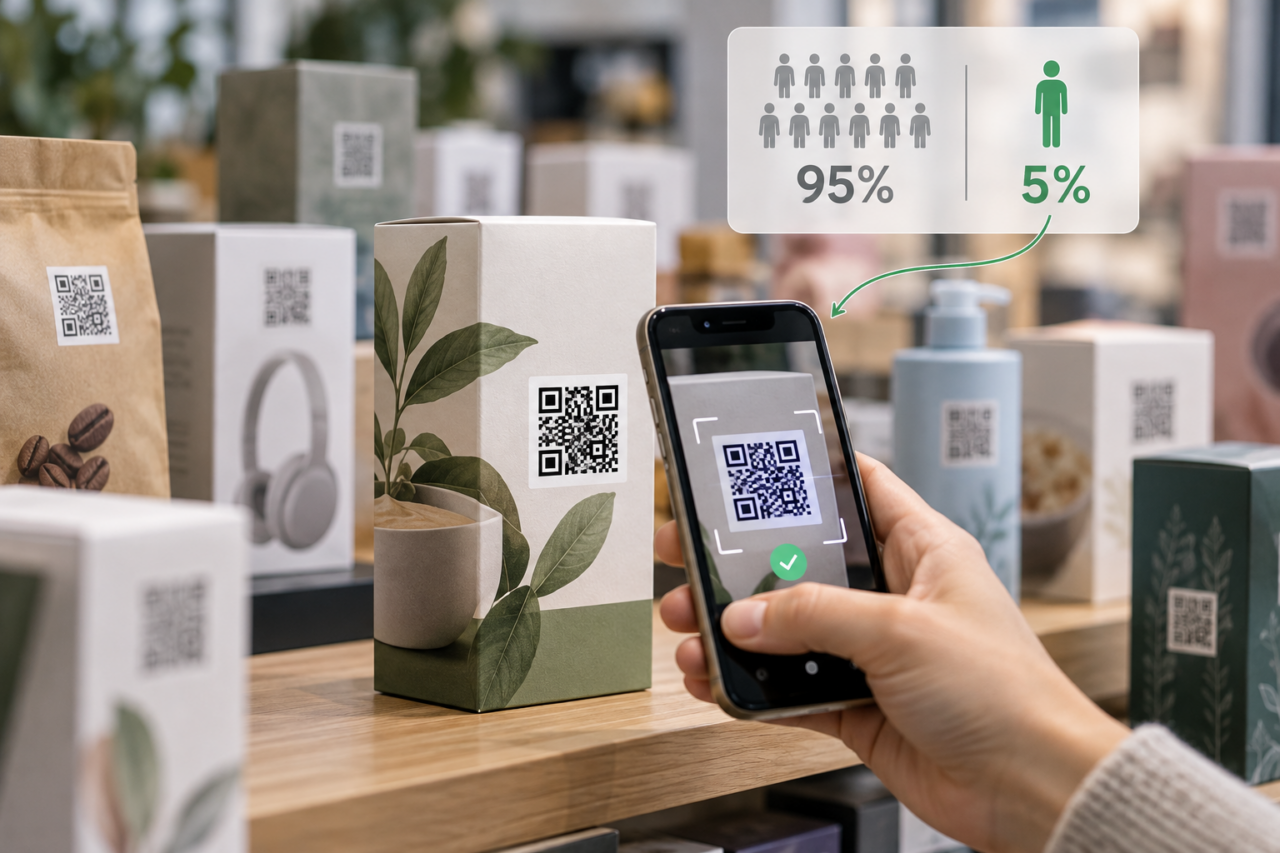
QR codes are now printed on bottles, food packaging, cosmetics, appliances and countless other consumer products. Brands use them to provide additional product information, instructions, videos, warranty registration, feedback forms, recipes or access to online services. The technology has become cheap, familiar and extraordinarily easy to deploy.
That convenience may also explain why so many codes accomplish very little. Generating one takes minutes. Adding it to an existing packaging design is relatively straightforward. The result gives a physical product a digital extension without requiring the business to rethink the experience itself. A QR code appears, a short “Scan me” message is added beside it, and the company hopes curiosity will do the rest.
Scanova’s 2026 consumer-goods benchmark suggests that curiosity is not enough. Across roughly 46.9 million scans and thousands of live packaging codes, the top 5.06% account for 94.5% of all scanning activity. The median code receives just 21 scans over its lifetime, while 18.8% of live codes have never been scanned at all. (scanova.io)
The technology works perfectly well. What often fails is the reason to use it.
A QR code is not a value proposition
Marketing teams can easily focus on the mechanism before addressing the motivation. They discuss where the QR code should appear, how large it should be, whether it should be dynamic and how scans will be measured. The more important question sometimes comes later: why should a customer interrupt what they are doing, take out a phone and scan this particular code?
“Learn more” is rarely a sufficiently strong answer. The customer is already holding the product. Sending them to a corporate homepage or a generic brand website asks them to make an additional effort without clearly explaining what they will receive in return. The code technically works, but the perceived value of scanning it is close to zero.
Scanova’s data illustrates the difference sharply. Purpose-built product pages generate an average of 28,914 scans per code in its packaging dataset, compared with 4,017 for codes that simply redirect to a general website. How-to video codes also perform strongly, despite being used by relatively few of the brands in the benchmark. (scanova.io)
The difference is not the square printed on the package. It is the usefulness of what sits behind it. Assembly instructions for an appliance, precise allergen information, a recipe directly related to the food in someone’s hand, recycling guidance or an easy warranty-registration process each answer an identifiable need. A corporate homepage usually does not.
Consumers do not scan because a marketer wants them to scan
Digital marketing has encouraged businesses to think of almost every interaction as a potential channel. Packaging becomes a traffic source, a receipt becomes an acquisition opportunity and a QR code becomes a route towards a mailing list, a social account or another campaign.
Consumers do not experience the world through a marketing funnel. They evaluate usefulness. Before scanning a code, even unconsciously, they make a tiny calculation: what am I likely to get, and is it worth the effort? If the answer is unclear, nothing happens.
The same principle appears elsewhere in consumer behaviour. Amazon is reshaping the holiday shopping calendar not simply because it tells customers that October should become a shopping period, but because it provides a sufficiently clear economic incentive for them to change behaviour. A company cannot manufacture a habit merely by creating a touchpoint. It needs a reason strong enough for people to use it.
In that sense, the humble QR code becomes a surprisingly effective test of marketing relevance. Every scan means the promise beside the code was compelling enough to justify an extra action. Every ignored code is evidence that it may not have been.
Packaging should answer a question created by the product
The strongest QR experiences usually begin with context. Someone who has just bought a kitchen appliance may need installation guidance. A shopper looking at food packaging may want origin, ingredient or allergen information. A wine buyer may want tasting notes, provenance or pairing advice. The useful destination depends less on what the brand wants to communicate and more on what the customer might reasonably need at that exact moment.
This is why a generic website redirect can feel so disappointing. It breaks the context. The customer scans a specific product and arrives somewhere that requires them to begin searching again. Technically, the company has connected physical packaging to its digital ecosystem. Practically, it has failed to complete the journey.
This distinction is becoming more important as the retail industry moves towards wider adoption of two-dimensional barcodes. GS1’s Ambition 2027 aims for retail point-of-sale systems globally to be capable of reading and processing defined GS1-compliant 2D barcodes by the end of 2027. These codes can carry richer product data and connect consumers with digital information covering areas such as ingredients, allergens, recycling, traceability and usage. (gs1.org)
QR codes and other 2D formats are therefore likely to become even more common on packaging. The scarce resource will not be the code itself. It will be the consumer’s attention.
Scan data only matters if brands understand what it represents
One genuine advantage of QR codes is measurability. A printed statement or image on a package rarely tells a marketer whether someone acted on it. A scan creates an observable interaction and can reveal when, where and how often a particular code is used.
But raw scan numbers can become misleading when stripped of context. A low-performing code does not necessarily prove that consumers dislike QR codes. It may have been poorly positioned, weakly explained, linked to an irrelevant destination or placed next to information nobody needed. Conversely, a high scan count does not guarantee value if users reach a disappointing page and immediately leave.
The useful questions therefore begin after the scan count. Which content creates action? At what point in the customer experience? On which products? What happens after the scan? Does the interaction solve a problem, improve the experience, support loyalty or produce information the company can use intelligently?
This is where QR performance becomes part of a broader marketing strategy focused on customer behaviour and the levers that genuinely support business development. Marketing does not become stronger simply because another digital feature has been attached to a product. It becomes stronger when the company understands why that interaction deserves to exist.
The concentration of scans is really a story about usefulness
It would be easy to read Scanova’s benchmark as evidence that QR codes generally fail. That is not what the numbers show. They show an extraordinarily uneven distribution of success. The best-performing packaging code in the dataset has generated more than 2.7 million scans, while thousands of others receive almost no attention.
QR codes are therefore neither obsolete nor magical. They magnify the quality of the idea behind them. When scanning reveals information that is immediately relevant, eliminates friction or provides something physical packaging could not reasonably contain, the behaviour makes sense. When the code exists because someone decided modern packaging ought to include one, it becomes little more than another design element.
The lesson extends far beyond packaging. Adding technology does not automatically create value. Adding a channel does not automatically create a relationship. Adding a feature does not automatically create usage.
Customers are under no obligation to complete the journey a brand designed for them. They use what helps and ignore what does not.
A QR code occupies only a few square centimetres of packaging, but it asks a much larger marketing question: do we genuinely have something useful enough to justify the customer’s next action?
👉 Are you adding more customer touchpoints without knowing which ones genuinely create value? Let’s identify the marketing priorities that deserve your investment.
Written by Julien Ricciarelli-Bonnal
12 October 2026