


Written by Julien Ricciarelli-Bonnal
1 November 2026
The Essentials
When a retailer sells a €100 gift card, it receives the money immediately, even though no product has yet been selected or delivered. Behind this familiar gift lies a business model combining advance cash flow, future purchasing commitments and the possibility of attracting new customers. Some recipients spend more than the card’s value, while others never use their entire balance. Yet the initial payment is not automatically revenue or profit: the retailer still has an obligation to honour the card. Understanding these differences reveals why gift cards are commercially attractive, how unused balances affect the economics of the programme and why a successful scheme must deliver value to customers as well as retailers.
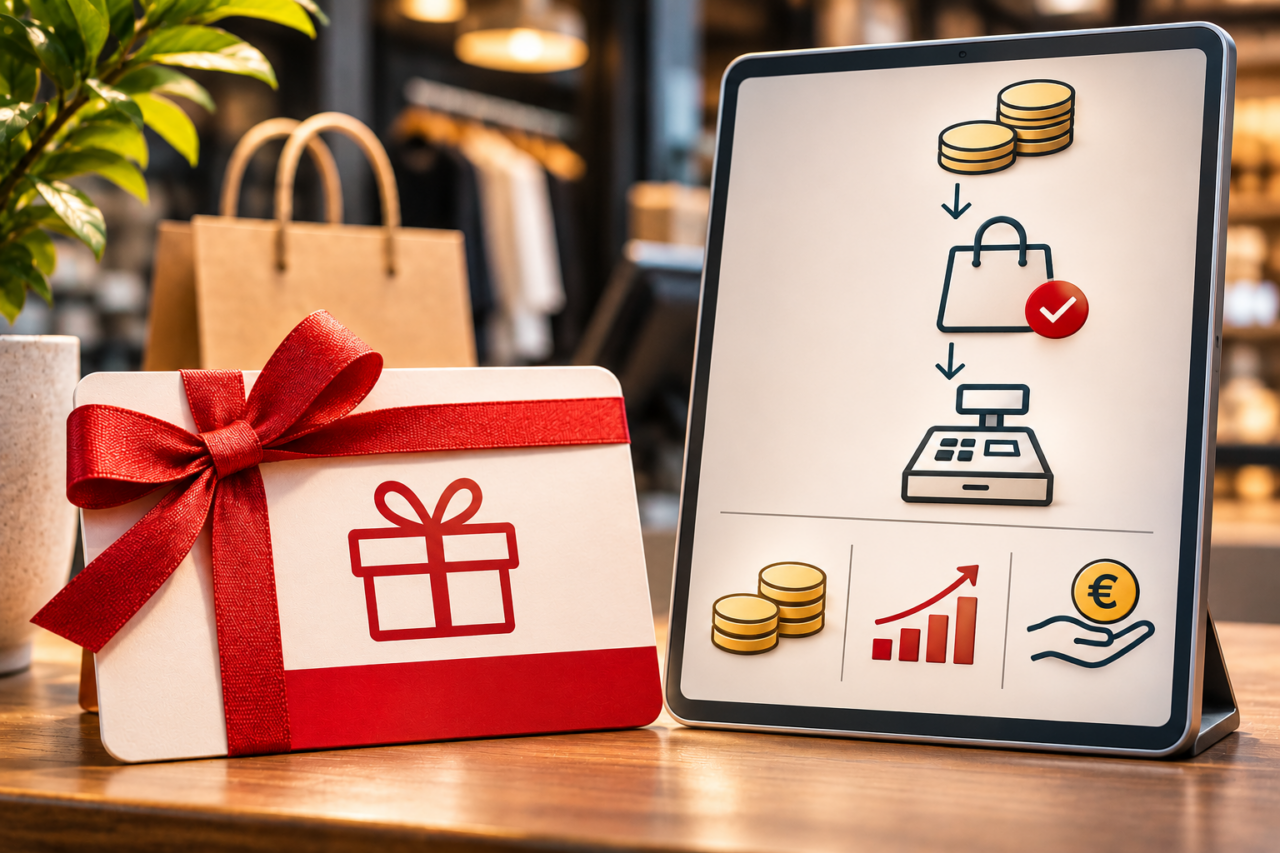
Gift cards are usually presented as a practical alternative to choosing a present. Instead of guessing which book, item of clothing or piece of equipment someone might appreciate, the purchaser gives them a fixed amount to spend at a chosen retailer. The recipient retains a degree of freedom, while the person buying the gift avoids the uncertainty associated with selecting the wrong product.
For the company issuing the card, however, something more interesting is happening. The retailer receives payment before knowing what the recipient will buy, when they will visit or whether the entire balance will ever be spent. In a conventional transaction, payment and the delivery of value are closely connected. Gift cards separate those two events, sometimes by several months.
That distinction makes them more than convenient presents. They are commercial instruments that influence cash flow, customer behaviour and the timing of future sales. For large chains, even relatively modest changes in how customers use their prepaid balances can become financially significant. For smaller retailers, the same mechanism may offer an additional way to finance operations and introduce new customers to their businesses.
Receiving Payment Today for Products Delivered Tomorrow
In a conventional retail purchase, customers select a product and pay for it. The merchant knows what has been sold and can account for the cost of providing it. With a gift card, the customer purchases a right to obtain goods or services later, subject to the conditions of the programme. The particular goods and their eventual cost to the business remain unknown at the time the money arrives.
This timing can be economically useful. Consider a shop that sells 500 gift cards worth €100 each during the holiday season. It receives €50,000 in cash, even though many recipients may not visit until the following weeks or months. The business has access to funds before fulfilling the corresponding purchases, potentially easing the pressure created by inventory costs, supplier payments and other operating expenses.
The arrangement can provide a form of customer-funded working capital, but it should not be confused with a loan that has no obligations attached. The retailer must remain capable of supplying the goods or services customers are entitled to receive. The cash belongs to the business’s financial resources, while the commitment associated with the outstanding cards remains on its balance sheet.
Under widely applied revenue-recognition principles, payment for an unredeemed gift card is generally recorded as a liability or deferred revenue. Revenue is recognised as the retailer fulfils its obligation when the card is redeemed, subject to the applicable accounting rules. Cash collection and revenue recognition therefore occur at different points in time.
This distinction matters when assessing performance. A business that sells a substantial number of gift cards in December may report a stronger cash position without having earned all the associated revenue in that month. If management treats the incoming funds as immediately available profit, it risks spending money needed to honour future purchases.
The Store Is Chosen Before the Product
Gift cards also influence where future spending takes place. Someone holding €100 in ordinary funds can compare retailers and decide where to shop. Someone receiving a €100 gift card for a specific chain has a financial incentive to spend that amount there, even if they have not yet chosen a product.
For the retailer, this represents a valuable commercial commitment. The business has effectively secured an opportunity to serve a customer before the customer’s final purchase decision. It still needs to offer attractive products and a satisfactory shopping experience, but it faces less uncertainty about where the prepaid amount will be spent.
The mechanism works differently for multi-retailer gift cards. In those arrangements, a separate issuer may collect the initial payment, while participating merchants receive funds only when a card is used and the relevant settlement takes place. Fees, contractual conditions and responsibility for outstanding balances vary between programmes. It would therefore be misleading to assume that every shop accepting gift cards receives the same cash-flow advantage as a retailer issuing its own cards.
Another distinctive feature is that the purchaser and the eventual customer are often different people. A parent might buy a card for a teenager, an employer might distribute cards to staff, or a company might offer them to business partners. The retailer can consequently reach consumers who might never have considered visiting its stores independently.
Yet bringing someone into the store does not guarantee a lasting customer relationship. The product must be available, the conditions must be clear and the shopping experience must meet expectations. The problem is particularly visible when a recipient visits to purchase a specific item and discovers that it is unavailable. As we examined in our analysis of how stockouts can cost businesses far more than one lost sale, an unsuccessful shopping experience can have consequences that continue well beyond the immediate transaction.
Why Gift Cards Can Encourage Additional Spending
A gift card’s value rarely corresponds perfectly to every product a recipient might want. Someone with a €100 card might find an attractive item priced at €135 and decide to pay the additional €35 personally. The retailer then completes a transaction worth more than the original prepaid amount.
This possibility is particularly interesting for retailers with products sold across different price points. A card may encourage a customer to consider a more expensive product than they would otherwise have purchased. It can also lead recipients to explore departments, accessories or supplementary services that were not part of their original intentions.
However, additional spending should not be treated as an automatic result of gift card ownership. Some recipients choose products that match the available balance closely. Others divide the amount across several visits when the terms permit it. Customers who spend beyond the card’s value may also have made the same purchases without receiving a gift card.
For sound financial analysis, the distinction between a larger transaction and genuinely incremental spending is essential. If a customer buys €140 of merchandise using a €100 card and €40 of personal funds, the retailer has processed a €140 sale. It does not follow that the entire transaction, or even the additional €40, represents new demand created by the card.
The company should also consider contribution margin. An additional €40 purchase is not worth €40 in profit, because the products sold have costs. Discounts offered to encourage card purchases, processing fees and programme administration may further reduce the economic benefit.
The strongest programmes are therefore not necessarily those that encourage the largest supplementary payments. They are the ones that produce profitable purchases, worthwhile customer experiences and relationships that may extend beyond the initial redemption.
The Financial Significance of Money That Is Never Spent
Not every gift card is redeemed in full. Some recipients lose their cards, forget about them or leave a small remaining balance unused. Others may be unable to use the card after a valid expiration date, depending on the conditions and laws governing the programme.
In accounting terminology, the portion of prepaid value that is not expected to be redeemed is commonly called breakage. It is an important concept because the retailer has received money for goods or services it is increasingly unlikely to be asked to provide.
The scale can be remarkable. Starbucks reported in its 2025 annual financial statements that it recognised $200.4 million in breakage revenue associated with stored-value cards in company-operated stores, together with $22 million in licensed-store revenue. The combined amount was $222.4 million.
This example requires several qualifications. Starbucks stored-value cards are frequently reloaded and used for everyday payments, rather than exclusively as gifts. Breakage revenue is also not the same thing as net profit. Furthermore, Starbucks notes that cards in many of its company-operated markets do not expire, so these figures cannot simply be described as revenue from expired gift cards.
Accounting treatment depends on the ability to estimate balances that are unlikely to be redeemed and on applicable legal obligations. Under relevant revenue-recognition standards, expected breakage may be recognised in proportion to actual redemptions when the necessary conditions are satisfied. In other situations, revenue recognition may need to be postponed until the likelihood of a customer exercising their rights becomes sufficiently remote.
Certain jurisdictions also have rules requiring unused amounts to be returned or remitted to public authorities. Retailers cannot simply decide that an outstanding balance becomes income because the customer has not used it for several months.
Nevertheless, breakage helps explain why gift card programmes attract financial interest. When millions of cards and stored-value balances circulate, even a small proportion of permanently unused funds can become material. The responsible commercial objective, however, should not be to make cards difficult to redeem. Customer frustration, reputational damage and regulatory problems could easily outweigh the financial benefit.
A Gift Card Can Create a Customer, but Not Customer Loyalty
Gift cards are particularly attractive to businesses because the transaction creates two possible commercial relationships. The person buying the card has chosen the retailer as a suitable place to spend money, while the recipient may discover that retailer for the first time. A successful programme can therefore contribute to customer acquisition as well as cash collection.
Corporate purchases add another dimension. Employers and organisations sometimes distribute cards as staff rewards or gifts for business partners. A retailer may consequently receive a large order from one organisation, while the actual shopping visits occur later and involve many different people.
These commercial opportunities should not be confused with guaranteed loyalty. A recipient might use the balance once, purchase only the necessary items and never return. Another might enjoy the experience, discover a product category and subsequently become a regular customer. The difference depends on what happens during and after the visit, not merely on the existence of the prepaid balance.
A strong commercial strategy built around customer acquisition and retention therefore needs to distinguish between card purchasers, card recipients and customers who return after redemption. Measuring these groups separately helps reveal whether the programme is introducing genuinely new demand or mainly shifting the timing of purchases that would have happened anyway.
Timing also affects operations. Gift cards purchased during a holiday season may be redeemed during subsequent sales periods, sometimes when stores are already busy. For restaurants, spas or other service providers, cards create future commitments that depend on available appointment slots and staffing capacity. Advance payment is valuable only if the business can fulfil the associated demand without sacrificing service quality.
The Model Works Only When the Economics Remain Under Control
A gift card programme needs reliable administration. Retailers must track issued balances, partial redemptions, refunds where applicable, fraud attempts and the security of digital codes. If the programme is operated through a third-party platform, commission and technical costs may need to be included in its profitability calculations.
Clear conditions are equally important. Customers should understand where the card can be used, whether it can be spent in several transactions, how its balance can be checked and what happens if it is lost or reaches its expiration date. Confusing restrictions can create disputes and make recipients feel that a gift has become a problem.
Tax rules also require attention. Within the European framework, for example, different VAT treatments can apply to single-purpose and multi-purpose vouchers. The point at which tax becomes chargeable is not necessarily identical for every type of card. International retailers must therefore consider the legal and fiscal structure of each programme rather than apply one assumption across all markets.
The most useful performance indicators extend beyond the total face value of cards sold. Businesses should examine outstanding liabilities, average redemption periods, unused balances, additional payments, customer retention, gross margins and the costs of running the programme. These measures reveal whether advance payments are creating sustainable economic value or merely bringing future revenue forward in cash terms.
Gift cards reveal an unusual feature of modern retail: a business can receive payment before its customer has decided exactly what to buy. The arrangement improves the timing of cash collection, directs spending towards participating merchants and can introduce new shoppers to a brand. It may also generate additional purchases and, under appropriate conditions, revenue associated with balances that will never be used.
But the financial advantage does not remove the underlying commercial obligation. Getting paid before delivering is useful. Turning that advance payment into profitable sales and customers who genuinely want to return is what makes the model sustainable.
Written by Julien Ricciarelli-Bonnal
1 November 2026