


Written by Julien Ricciarelli-Bonnal
30 September 2026
The Essentials
McDonald’s is using a machine-learning pricing engine to recommend what it considers the optimal price for products in individual restaurants, drawing on factors including transaction data, local competition and customers’ sensitivity to price. The objective is no longer simply to cover costs or respond to inflation, but to estimate how much consumers in a given area are willing to pay. Franchisees remain free to set their own prices. But the shift raises a much broader question: when artificial intelligence allows companies to adjust prices ever more precisely to willingness to pay, what does the price of a product still actually represent?
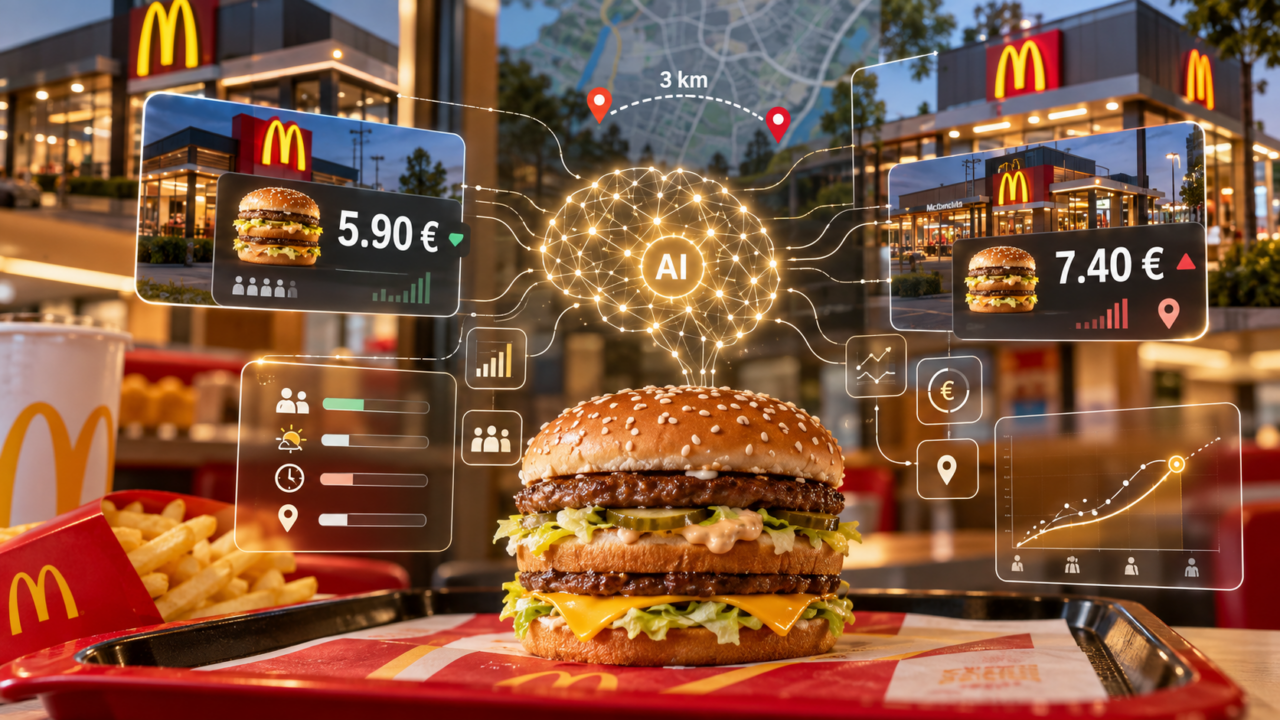
For decades, the price of a Big Mac had something almost reassuring about it. It varied across countries, tax systems, cost structures and standards of living, to the point that the famous Big Mac Index turned the burger itself into an economic indicator. Within the same market, nobody necessarily expected exactly the same price everywhere, but the amount still appeared to reflect a relatively understandable combination of restaurant costs, commercial strategy, competition and expected margin.
Artificial intelligence now makes it possible to go much further. According to an investigation by Reuters, McDonald’s uses a pricing engine that analyses millions of transactions across nearly 14,000 US restaurants to recommend prices for individual products and locations. Among the factors considered is an estimate of local customers’ willingness to pay.
That does not mean McDonald’s examines an individual customer before deciding how much to charge for a burger. The system operates at restaurant and local-market level, and franchisees remain officially free to accept or reject its recommendations. But the logic is already different enough to change the way we think about price. The question is no longer only how much a product costs or what margin a company wants to make. It increasingly becomes how far the price can rise before enough customers change their behaviour to make the increase counterproductive.
The Big Mac therefore becomes an unusually effective symbol of a transformation that reaches far beyond fast food.
The “right price” can increasingly mean the price customers will tolerate
Pricing according to willingness to pay obviously did not begin with artificial intelligence. Companies have always tried to understand how much customers are prepared to spend. Market research, pricing tests, segmentation, elasticity analysis and competitor monitoring have pursued the same objective for decades.
What changes with machine learning is the volume of information that can be processed and the precision of the resulting recommendations. McDonald’s pricing engine can analyse the performance of millions of transactions, compare how customers responded to previous price changes and take into account the prices offered by local competitors such as Burger King or Wendy’s. Instead of producing only a national pricing policy, the company can generate a recommendation for a specific restaurant.
Reuters found, for example, a Big Mac priced at $5.69 at one restaurant in Fresno, California, and $6.89 at another McDonald’s around three kilometres away. That represents a 21% difference. An important qualification is necessary: Reuters could not establish that this specific gap was directly caused by the algorithmic recommendations. McDonald’s also notes that restaurants located close to one another can belong to different markets and face different operating costs.
But the existence of the system itself illustrates how far pricing optimisation can now go. Price no longer has to be constructed primarily from the product and then tested against the market. The logic can increasingly work in reverse: observe the market, estimate what it will accept, then determine the price most likely to extract the strongest commercial performance.
This is not yet a personalised price for every customer
It would be tempting to tell this story as though two people ordering the same Big Mac in the same restaurant could receive different prices based on their personal profiles. That is not what the Reuters investigation describes.
McDonald’s pricing engine recommends prices at restaurant level. It assesses factors including local consumers’ price sensitivity, but nothing publicly reported shows the company using an individual customer’s personal data to charge that person more because the system has concluded that they can afford it.
That distinction matters because several different forms of algorithmic pricing are increasingly being grouped together in public debate. Prices can vary according to location, time, demand, availability, customer segment or, in the most controversial scenarios, individual characteristics. Airlines, hotels and ride-hailing platforms have already accustomed consumers to certain kinds of variation. Fast food, however, touches a far more ordinary, frequent and immediately comparable purchase.
That is also what makes the issue particularly interesting from a marketing perspective. Price is never only a financial figure. It shapes perception, sets expectations and contributes directly to positioning. Marketing coherence depends on aligning positioning, perceived value, pricing and execution rather than treating each as a separate decision. A pricing policy therefore always communicates something about the company and about the relationship it wants to build with its customers.
With AI, that relationship may simply become much harder to read.
Perfect optimisation can become a trust problem
From an economic perspective, searching for the optimal price is hardly irrational. A price that is too low leaves margin on the table. A price that is too high reduces volume. Somewhere between the two theoretically lies a point that maximises revenue or profitability, depending on the objective.
AI promises to locate that point more precisely and update it as behaviour changes. McDonald’s can even use the same engine in the opposite direction from what consumers might instinctively expect. Reuters reports that some recent recommendations have encouraged greater moderation, and in some cases lower prices, as the company tries to win back customers who have become increasingly sensitive to the cost of eating out.
The difficulty begins when economic optimisation collides with customer perception. Consumers generally accept that a restaurant at an airport or motorway service area costs more because they intuitively understand the reasons behind the difference. They may react differently if they feel a price is higher simply because an algorithm has calculated how far their local market can be pushed.
The distinction is subtle but important. The first price appears to reflect an economic reality. The second can feel as though it is measuring how much a customer group can absorb.
That is why companies using these technologies will need to integrate pricing into a broader reflection on their marketing strategy, positioning and the value customers actually perceive. An algorithm may identify the price that maximises a short-term commercial metric. It does not necessarily measure what a succession of difficult-to-understand price differences does to trust, attachment to the brand or perceptions of fairness.
After dynamic pricing comes calculated pricing
Consumers already live in an environment where prices move constantly. A train or plane ticket can cost more a few hours later, a hotel room changes according to occupancy, and a ride-hailing fare increases when demand surges. In those situations, the variation at least follows a relatively visible logic: a resource becomes scarcer or more heavily demanded.
Systems designed to estimate willingness to pay introduce something slightly different. They no longer simply measure the state of a market. They attempt to model how customers will react to price. The question is no longer only “how much should we sell this for?” but “how much can we charge here before buying behaviour changes enough to make the increase unprofitable?”
That logic can perfectly well lead to lower prices when an algorithm concludes that reducing the price will generate enough additional demand. It can also help companies adapt their offer to very different local economic realities. It would therefore be simplistic to describe algorithmic pricing automatically as a machine designed to make consumers pay as much as possible.
But it does gradually change the nature of price. Price is no longer only the result of cost, margin and positioning. It also becomes a behavioural prediction.
That may be where McDonald’s opens a debate much larger than the price of a hamburger. Artificial intelligence allows companies to understand with increasing precision the thresholds at which customers react, the differences they tolerate and the point at which they stop buying. Used intelligently, that knowledge can improve an offer and prevent absurd pricing decisions. Taken too far, it can leave customers feeling that the brand is no longer trying to decide what its product is worth, but simply to discover how much it can take before they say no.
And that difference is still much harder to calculate than an optimal price.
If your pricing policy, positioning or changing customer behaviour is forcing you to rethink your marketing decisions, we can help you turn those signals into choices that remain consistent with your market and strategy.
Written by Julien Ricciarelli-Bonnal
30 September 2026