


Written by Julien Ricciarelli-Bonnal
16 October 2026
The Essentials
A shopper spends time choosing products, reaches the checkout and leaves without completing the order. To an online retailer, this looks like a sale lost at the last possible moment. Yet placing an item in a cart does not necessarily mean that a purchasing decision has been made. Some customers are comparing prices, exploring alternatives or saving products for later. Others genuinely intend to buy but encounter unexpected delivery charges, unnecessary registration requirements or reasons to doubt the retailer’s reliability. Treating every abandoned cart as the same problem can lead businesses to invest in the wrong solutions. The priority is identifying which abandonments reflect normal shopping behaviour and which result from barriers the retailer can remove.
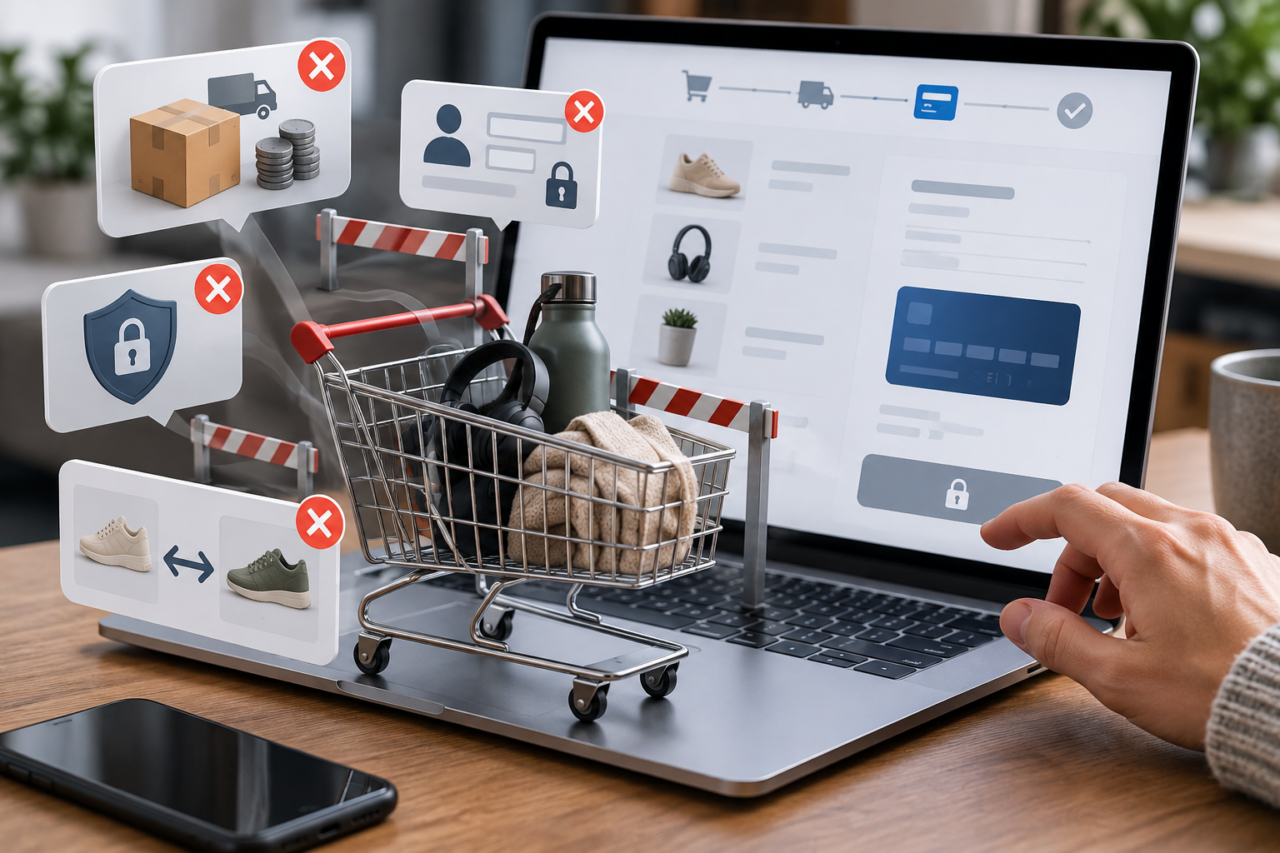
An online shopper selects a pair of shoes, adds another item to compare the total price and proceeds towards checkout. After reviewing delivery costs and entering some personal details, the shopper closes the page. No order is placed. From the retailer’s perspective, the customer travelled almost the entire purchasing journey before disappearing, leaving behind a transaction that appeared to be within reach.
It is tempting to interpret this behaviour as a failure of conversion. After all, attracting that visitor may have involved advertising expenditure, search engine optimisation, promotional campaigns or considerable investment in the product catalogue. The business has spent resources bringing someone close to a transaction, only for the expected revenue never to materialise.
The scale of the phenomenon reinforces this frustration. Baymard Institute’s compilation of 50 studies puts the average documented shopping cart abandonment rate at 70.22%. However, this figure combines research conducted across different contexts and should not be interpreted as proof that seven out of ten customers abandon purchases they had already decided to make. Understanding that distinction changes how retailers should approach conversion problems.
Adding a Product to a Cart Is Not a Commitment to Buy
In a physical shop, customers regularly examine products, compare models, ask questions and leave without purchasing anything. Retailers may wish that every visitor became a buyer, but they generally recognise that browsing is part of the shopping process. Online, the shopping cart gives these exploratory activities a more measurable form, making them appear closer to an actual transaction.
The design of ecommerce platforms encourages shoppers to use carts for purposes other than immediate purchasing. Someone might add several products to compare prices, calculate delivery charges, check promotional eligibility or build a temporary shortlist. The cart functions as a decision-making tool, not simply as the final step before payment. Its existence demonstrates interest, but the strength of that interest remains uncertain.
Baymard’s research on abandonment reasons illustrates the point. In its survey of US online shoppers, 42% of respondents reported having abandoned a cart during the previous three months because they were browsing or not yet ready to buy. This does not mean that 42% of all abandoned transactions belong to that category. It does show that many shoppers use the purchasing interface while their decision is still developing.
A similar misunderstanding occurs in professional sales when prospective customers request quotations without ever making a purchase. In both cases, a business can interpret an exploratory action as evidence of a commitment that has not yet been made. A customer comparing three retailers may create three shopping carts before placing one order. The two abandoned carts do not necessarily represent failures; they may simply document the alternatives considered before reaching a decision.
This becomes particularly important for expensive products, unfamiliar brands and purchases that involve several people. Researching alternatives, checking return policies and revisiting the same product over several days can be rational behaviour. A retailer that confuses this process with checkout failure may focus too heavily on persuading undecided shoppers instead of removing the obstacles encountered by those who are ready to buy.
Unexpected Costs Can Change a Decision That Seemed Settled
Other abandonments have a more immediate commercial explanation. A shopper may have selected the right product, accepted its displayed price and decided to proceed, only to discover that the amount payable is significantly higher than expected. Delivery fees, taxes or additional charges can change the economic comparison on which the original decision was based.
In Baymard’s breakdown of abandonment reasons other than browsing, 40% of the relevant US respondents cited extra costs being too high. The figure describes reasons reported by surveyed shoppers, not a universal share of abandoned transactions. Nevertheless, it highlights a fundamental weakness in the purchasing journey: the price that attracts a customer is not always the price the customer is ultimately asked to pay.
Consider a product advertised at €39. During browsing, the customer compares it with alternatives in roughly the same price range. At checkout, a delivery charge of €8.90 brings the total to €47.90. The increase may be financially manageable, but it forces the shopper to reconsider a decision that previously seemed complete. A competing retailer offering a slightly more expensive product with delivery included may suddenly become the better option.
The difficulty is not necessarily the delivery fee itself. Customers understand that transporting physical goods costs money, and many will accept reasonable charges when they are clear from the beginning. Friction arises when the total cost appears unexpectedly late, particularly after the customer has already spent time entering personal information. What might have been an acceptable expense becomes an unwelcome surprise.
Eliminating all delivery charges is not automatically the best response. Smaller retailers may be unable to absorb logistics costs without damaging their margins. A more sustainable approach is to make pricing predictable, explain delivery thresholds and show meaningful estimates early enough for customers to compare offers fairly. Delivery speed deserves similar attention. A purchase required for a particular occasion may lose its usefulness if the estimated arrival date is revealed too late.
Checkout Friction Can Turn Buying into Unnecessary Work
Once a shopper has chosen a product, the remaining process should allow the transaction to be completed without demanding disproportionate effort. Yet checkout systems sometimes behave as though the customer’s primary objective were to create an account, provide detailed personal information or navigate the retailer’s administrative procedures rather than purchase an item.
Baymard’s research identifies mandatory account creation and overly long or complicated checkout processes among the reasons shoppers abandon their orders. In its breakdown excluding casual browsing, 18% of relevant respondents mentioned being required to create an account, while 17% cited checkout complexity. These reasons can overlap, but both illustrate how the retailer’s internal preferences may conflict with the customer’s immediate objective.
Account creation is a particularly revealing example. From the business’s perspective, registered customers can be easier to recognise, contact and retain. Purchase histories and account-based services may also support customer relationships over time. For someone buying a single product from an unfamiliar retailer, however, choosing a password and creating another permanent account can feel like an obligation unrelated to the transaction. Offering guest checkout, followed by optional registration, allows the purchase to happen without forcing a longer-term relationship.
Forms create similar difficulties. An address field that rejects valid information, unclear error messages, unnecessary telephone requirements or a promotional code that fails without explanation can all interrupt the purchase. These irritations are especially relevant on mobile devices, where typing is less convenient and interruptions are more frequent. The problem is not always the number of checkout steps, but whether each step makes sense to the person completing it.
A structured assessment of marketing priorities and the customer journey should therefore examine where the business introduces unnecessary friction and whether each requirement contributes to a successful transaction. Reducing complexity does not mean abandoning legitimate security checks or essential information gathering. It means preventing internal processes from becoming obstacles that customers are expected to overcome.
Trust Becomes More Important as Payment Approaches
The final stages of checkout also change the nature of the customer’s exposure. Browsing product information involves relatively little commitment. Entering payment details, confirming an address and authorising a financial transaction introduces concerns that may have remained secondary throughout the earlier stages of the visit.
According to Baymard’s survey, 19% of the relevant respondents cited a lack of trust in the website with their credit card information as a reason for abandoning checkout. This concern is not limited to whether the technology is objectively secure. Shoppers rarely possess the technical knowledge required to assess a payment infrastructure. Instead, they interpret the information, design and commercial behaviour visible to them as indicators of reliability.
A retailer can offer excellent products and competitive prices while still creating uncertainty through unclear return conditions, missing contact information or inconsistent delivery promises. An unfamiliar payment page may increase that hesitation, especially if the customer cannot understand how a refund would be handled if something went wrong. Credibility is built through the consistency of the entire shopping experience rather than through any single reassurance displayed at the final step.
Security logos and trust badges may help when they represent genuine protections, but they cannot substitute for transparent commercial conditions. Clear business information, familiar payment methods, accessible customer support and understandable returns policies make it easier for buyers to judge the transaction. The appropriate payment options also depend on the market, since customer expectations can vary significantly between countries and purchasing contexts.
Attempts to create artificial urgency can make the situation worse. Aggressive countdowns, ambiguous promotional conditions and repeated pressure to complete an order may be intended to accelerate conversion, but they can undermine confidence when customers are already uncertain. At the point where someone is deciding whether to share financial information, excessive persuasion can become another reason to leave.
The Real Opportunity Is to Separate Preventable Abandonment from Normal Behaviour
Retailers often respond to abandoned carts by increasing follow-up activity. Automated emails, targeted advertising, notifications and last-minute discounts are designed to recover transactions that did not initially convert. Such tools can produce results, but their effectiveness depends on the reasons behind the abandonment.
A reminder may be useful for someone who genuinely intended to return to an unfinished purchase. A discount offered to a shopper who encountered a technical error, however, compensates for a problem without resolving it. Giving price incentives to people who were only researching alternatives may also reduce margins without creating meaningful additional demand. Cart recovery should not become a substitute for understanding the purchasing journey.
The more useful diagnosis begins by distinguishing where customers leave. Abandonment before checkout, after delivery selection, during address entry or at the payment authorisation stage can point towards different problems. Analysing these patterns by device, traffic source, product category and customer segment can help identify barriers that would otherwise disappear within a single overall conversion rate.
Businesses should also connect these findings to financial performance. Free shipping may increase completed purchases while weakening margins on low-value orders. Removing steps from checkout may improve convenience, but unnecessary errors or higher processing costs can offset some of the gains. Conversion rate remains valuable, provided it is assessed alongside order profitability, operational efficiency and the quality of the resulting customer relationships.
Shopping cart abandonment is therefore not a problem that can or should be eliminated entirely. Customers need room to compare, hesitate and change their minds. A well-functioning ecommerce business will always have visitors who leave without buying. The meaningful distinction is between people who have not yet chosen to purchase and those who were willing to do so until the retailer gave them a reason to stop. For the second group, improving conversion often requires less persuasion and more consistency between the offer that attracted the customer and the experience of completing the transaction.
Written by Julien Ricciarelli-Bonnal
16 October 2026